*content warning: discussions of sexual assault and male violence*
What is the solution to male violence?
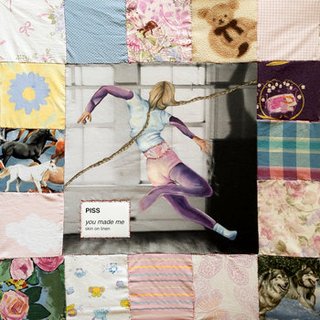
Vancouver-based four piece band PISS actively rails against this question in ‘you made me / skin on linen'. Exploring themes of sexual assault, trauma, grief and maniacal anger, PISS’ sonic thesis becomes a liturgy on abandoning faith and accepting the ambiguity of the somatic and emotional. Rather than reciting a story, or grasping at a solution through its lyricism, PISS cries through the raw, genderless, overwhelming emotion channeled through spoken word, archival interviews, punk, noise and more.
The humour of hearing a child confess their dreams to you is the discalibration of their worldview compared to yours. Based on two-dimensional, unadulterated experiences, a child’s confession reminds you of what you wanted at their age… and why exactly you didn’t become that. Childhood, in retrospect, feels like a suspended reality.
The opening song ‘kai and friends’ suspends you into that last version of yourself that felt truly hopeful; a fifty-three second recording of a group of children reciting their dreams to us. They laugh and shout as the song begins with a reverberating bass that cushions you into a technicoloured memory. The band plays devotionally to the innocence of these children and as the memory grows, you hope that Kai and their friends become ‘an astronaut’ or ‘an artist’ or ‘a football player’. The reality is disrupted when the final child that speaks is cut off. ‘When I grow up I want to be…’ Instead the song concludes abruptly and leaps into the second song titled ‘i wanted to be a singer’.
On the second track, the children continue to play but guitar and bass take over. The reverberating hum switches to a tight chested strumming melody only heightened by intervals of thrashing chords. You still hear the children softly in the background but as they laugh the chords reactively thrash louder until the children are crowded out by a restrained drum kick. The faith-filled past feels clawed from focus, with the only semblance of hope existing in restoring what’s left of you in the adulterated present. Pushed into a self-soothing ritual of chanting vocalised by Taylor Zantingh, she first caveats that ‘I don't know if writing about violence is helping me // Am I helping you?’ Before entering into stream-of-consciousness poetry about childhood dreams that are destroyed by male violence.
“I wanted to own an animal sanctuary with my baby sister // But I was bitten by a dog and now animals scarе me”
The music video for PISS’ ‘blocking a scene you can’t remember’ is a shaky camera that roves through the contents of a young girls room. Taylor, in righteously crazed grief, increasingly yells as the camera rolls around. The room is filled with books, a horse figurine, sewing patterns and drawings on the wall. We watch as a girl, sitting on polkadot cotton bedsheet stitches, cuts and sews a doll together with red thread. We listen to Taylor recite lines over and over. She is meticulous and obsessive. Beginning again and again as if rehearsing to herself. ‘A girl lies on her back in the dark, staring at the – cut, sorry. i can do better. again. interior, a girl's bedroom, nighttime.’
The song's lyrics blend into the scene as we watch Taylor’s poetry morphing with the girl’s silent sewing until Taylor becomes the girl's thoughts that we have intruded upon. The drums thud; the guitar is coppery and rich. As if sombrely meditative, the instruments create a bleeding lullaby for Taylor, or the girl, to grieve over as she sews and sews. And though the band keeps the same rhythm and pace throughout, Taylor becomes louder and faster. Her voice thrashes, almost breathless, now yelling at someone outside of us or the girls periphery. Taylor’s role shifts from trapped within the girl to defending her. The word ‘--cut’ transforms from meaning to begin again, to physically cut.
If this LP is a crisis of faith, then the final song ‘i keep trying to change the ending’ accepts the destabilising phenomena that sits at the heart of this crisis. Here she pleads and the band's pace and rhythm slowly crumbles with each line before eventually switching from an extension of Taylor’s voice to its opposition. Suddenly defiant against the singer, the snares shudder louder and louder before pausing to allow for her to whisper in-song ‘I won't bleed forever // I won't bleed forever’. The snares acting as a question mark rather than a full stop. The instruments then come back into fold, reverting back to their supportive role, as she comforts herself and we continue to bear witness. We hear her retrace the story told in this final song, vocalising key points of the story in an effort to find a new way to change the ending. “Horses // Soft hands // Singing // Trying // I won't bleed forever.”
Central to the sonic thesis of ‘you made me / skin on linen' is the space before the conclusion. The intimidating colosseum that is male violence requires a deeply complex solution that first involves actively listening to the victims at the heart of this epidemic. Without embodying the worlds that become destabilised by violent men, any concept of a solution can feel abstract, dehumanising, and more harmful than effective. Then, if solutions symbolise false-hope, PISS abandons it in the pursuit of the real that is grounded in the sonic embodiment of those same lived experiences.
Eventually the song concludes halfway through Taylor’s self-soothing lyrics, landing not on the hope that she ‘won’t bleed forever’ but her ‘singing’. Ultimately, regardless of hope, or futures ahead, the somatic found in singing keeps you looking forward.
Words by Yvonne Hong